When you purchase portable power gear via links on Sine & Cell, we may earn an affiliate commission at no added expense to you. How Sine & Cell earns affiliate commissions
Choosing the best solar generator comes down to a direct calculation: how many watt-hours (Wh) of energy you need to store, and how many continuous watts (W) your appliances draw. While marketed as self-contained "generators," these units are portable battery energy storage systems pairing a lithium iron phosphate (LiFePO4) battery pack with an internal pure sine wave inverter and a solar charge controller.
For weekend camp setups, camera batteries, and basic personal electronics, a compact unit in the 250Wh to 300Wh class provides easy portability without excess bulk. For emergency household backup, CPAP machines, and high-draw motor-driven appliances like full-size portable refrigerators, a 1,000Wh unit paired with a 1,800W inverter is the practical baseline. Below, we break down current portable power stations based on their verified listing specifications, advertised continuous output, and off-grid integration requirements.
1,000Wh Class: Mid-Size Workhorses for Backup and Basecamp
Units offering roughly 1 kilowatt-hour of capacity strike the most versatile balance between transportability and utility. At this capacity level, units can typically power essential high-draw AC appliances, provided their continuous running wattage falls within the inverter's limits.
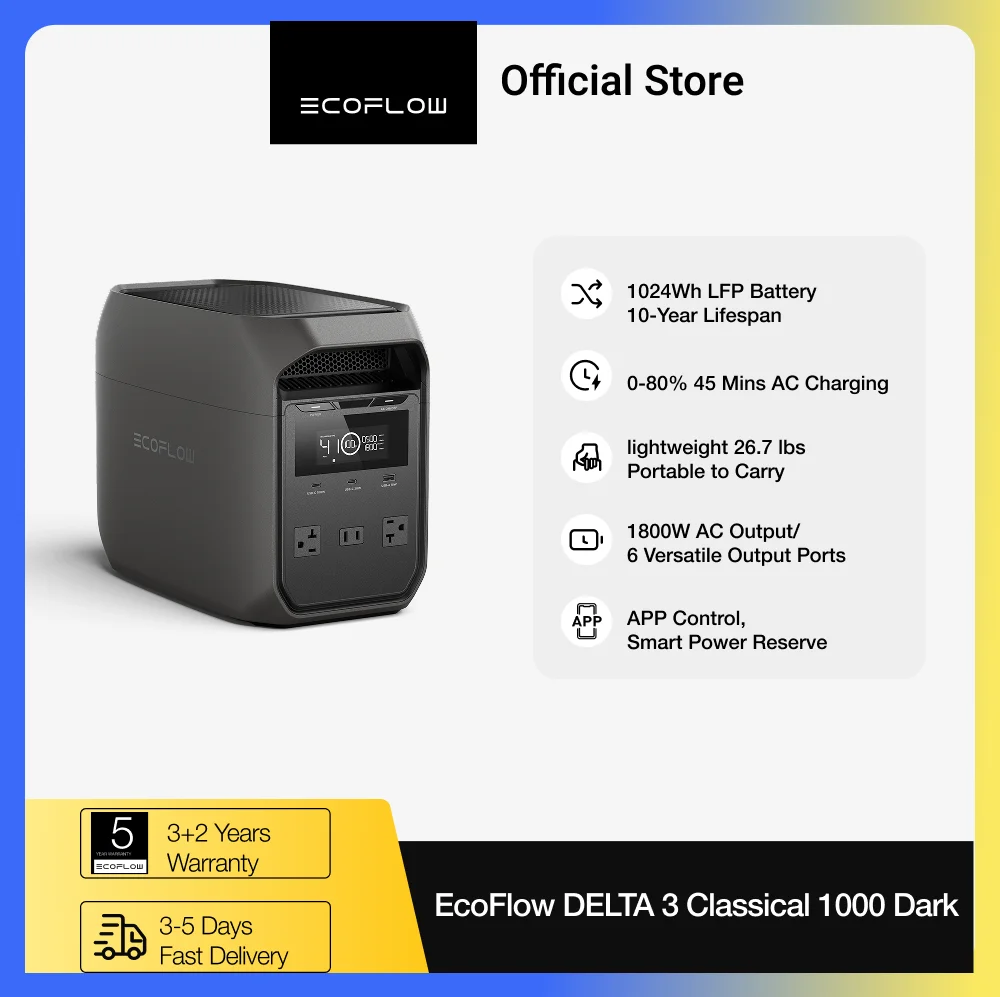
The EcoFlow DELTA 3 1000 provides an advertised 1,024Wh LiFePO4 battery paired with an 1,800W AC inverter. EcoFlow lists a 10-year lifespan metric on its product imagery alongside rapid 0–80% AC wall charging in 45 minutes, with a total carry weight listed at 26.7 lbs. The unit includes six AC outlets and a 100W USB-C output, managed via app connectivity. With 1,800W continuous output, it can handle typical heating and motor loads such as compact coffee makers, blenders, or sump pumps within rating bounds. Note that while marketed as a "solar generator," standalone power stations require compatible solar panels purchased separately to generate off-grid electricity.
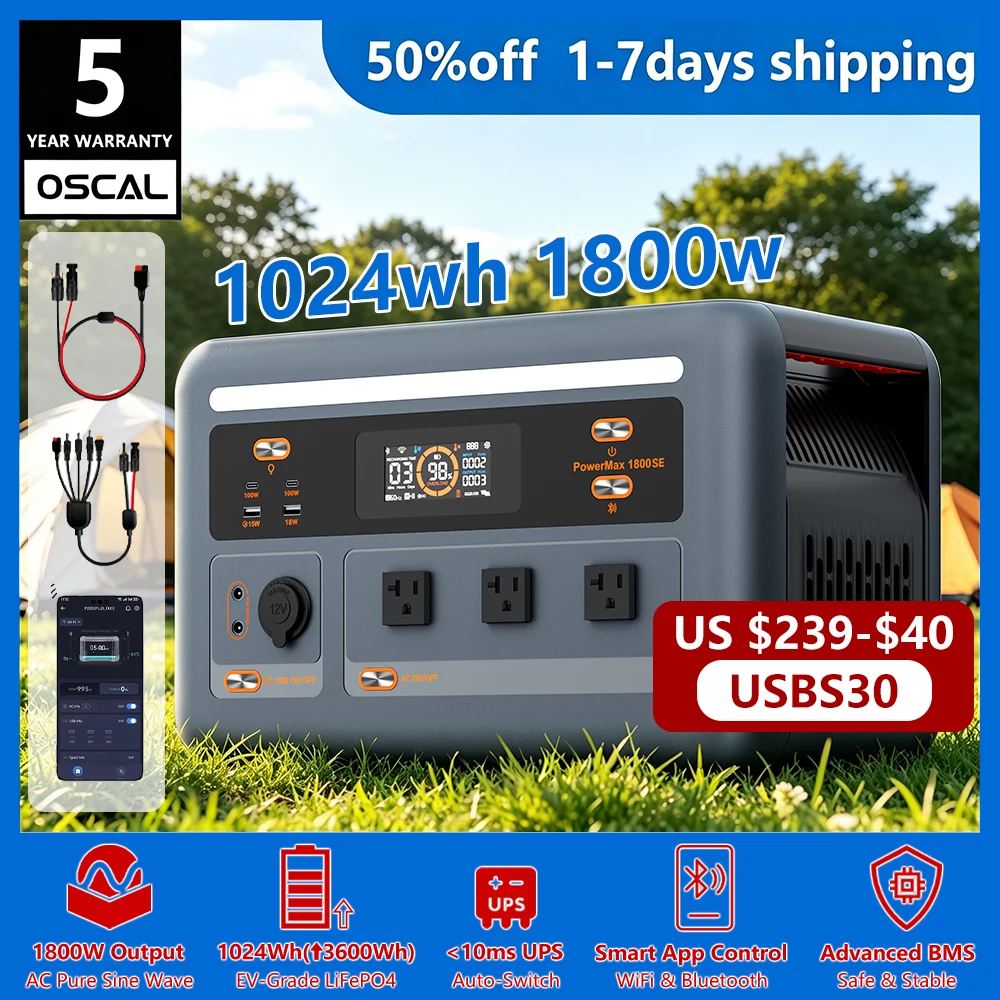
The OSCAL PowerMax 1800se matches the common 1,024Wh storage and 1,800W continuous output baseline (delivering 120V AC), while advertising a 3,600W surge threshold to assist with inductive motor starts. The seller claims a sub-10ms UPS (uninterruptible power supply) auto-switch function, 1-hour fast AC charging, and Wi-Fi/Bluetooth app telemetry. For users running sensitive electronics or small medical equipment during grid interruptions, an advertised fast UPS transfer switch helps prevent sudden drops, though buyers should verify their critical hardware's transfer tolerance against the manufacturer's manual.
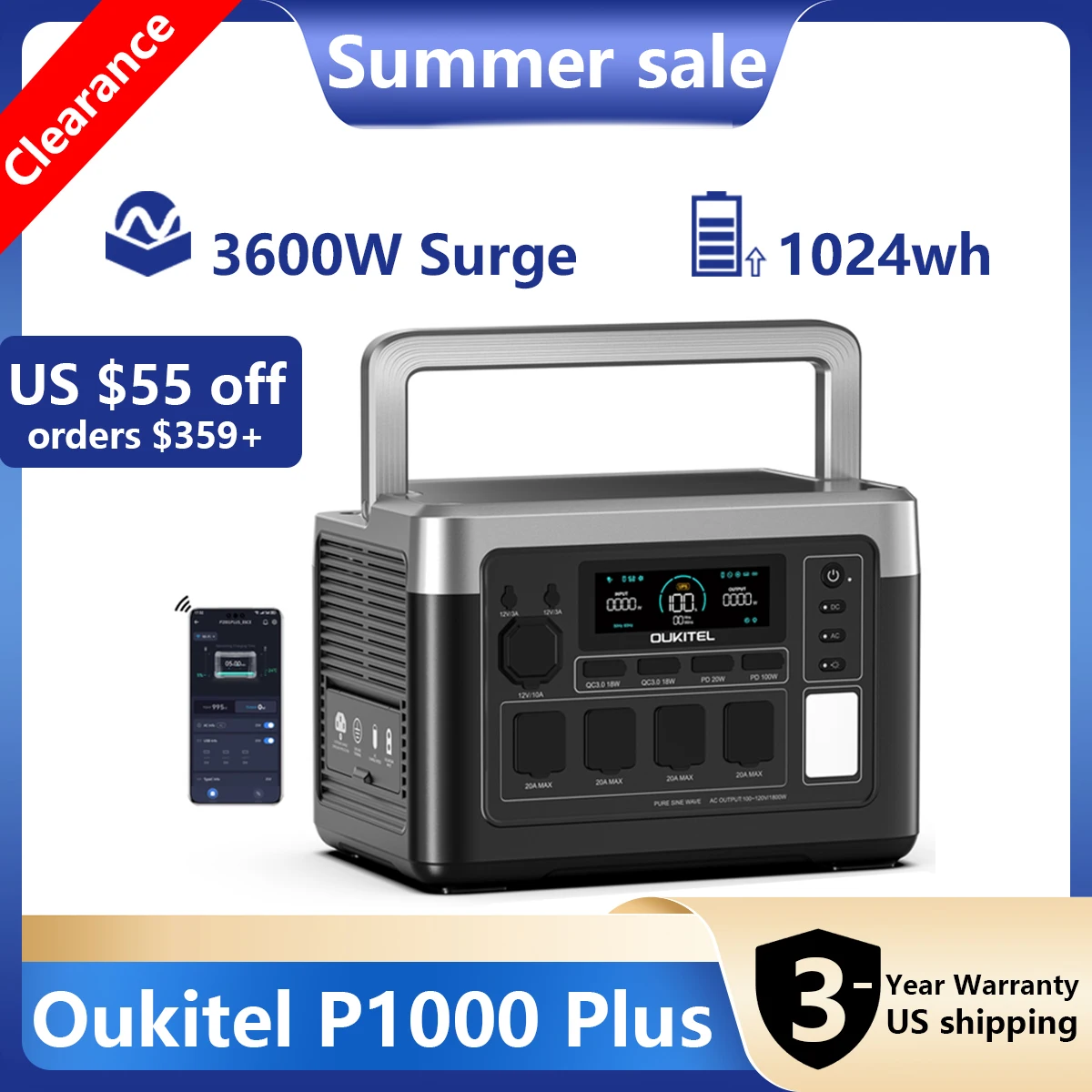
Sharing an equivalent battery and inverter footprint, the OUKITEL P1000 PLUS also specifies a 1,024Wh LiFePO4 battery pack, 1,800W continuous output, and a 3,600W surge capacity. The seller advertises 1-hour fast wall charging and lists a 3-year warranty on promotional materials. Its interface layout features four covered AC outlets, standard 12V DC ports, and dual fast-charge USB connections. Like its class peers, its utility off-grid depends entirely on your solar panel array's open-circuit voltage (Voc) matching the unit's onboard solar charge controller limits.
Compact Entry-Level: Lightweight Field Power
Stepping down in size dramatically cuts weight and cost, but limits what appliances you can operate. Compact units are intended for direct DC charging, drones, LED camp lighting, and small low-wattage electronics.
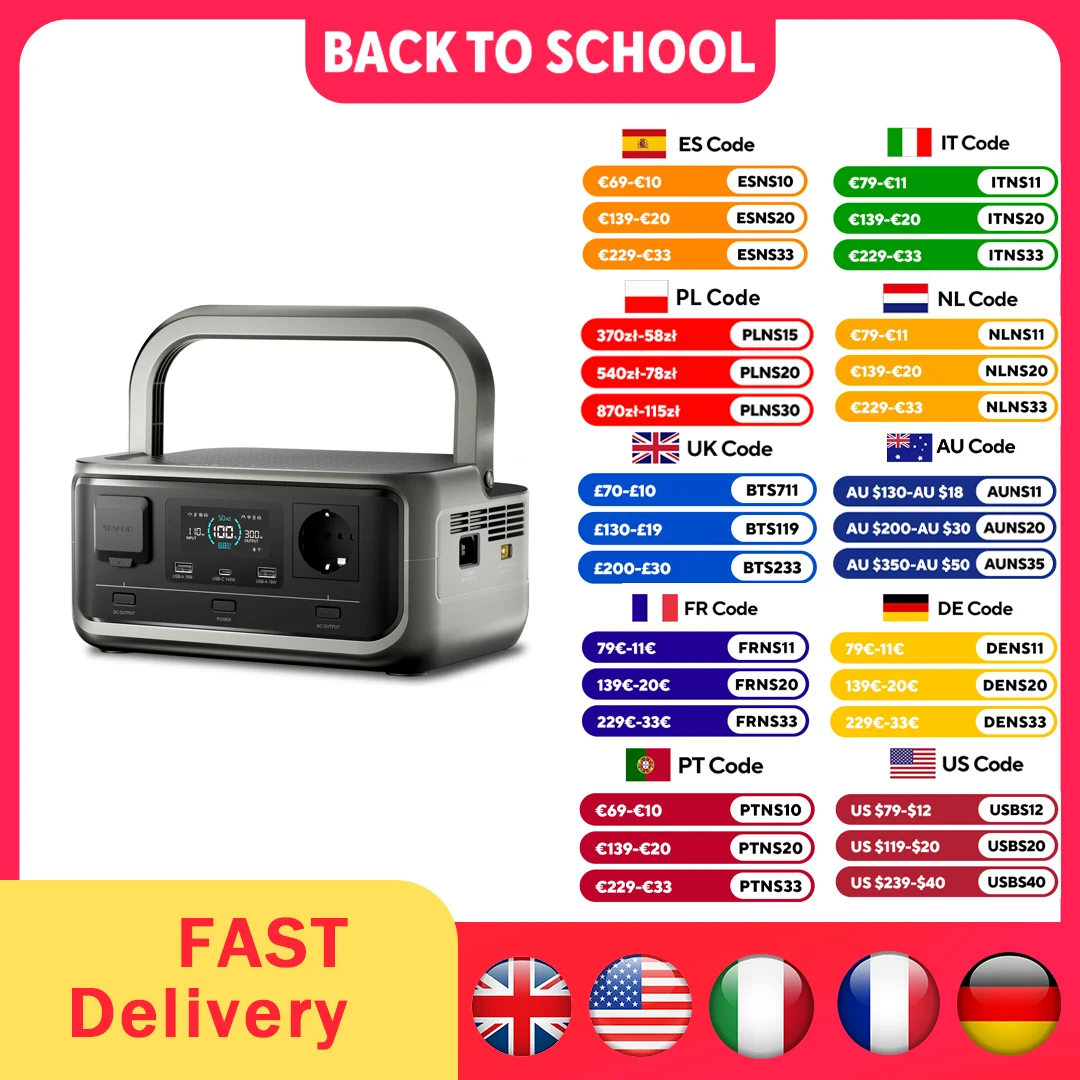
The ALLPOWERS VOLIX P300 delivers an advertised 256Wh LiFePO4 capacity with an inverter rated for 300W continuous output and 600W peak surge. Because 300W will not sustain heating elements, hair dryers, or heavy kitchen appliances, this unit is tailored for field computing, photography gear, and basic campsite lighting. At under 300Wh, it can also be replenished faster with smaller 60W–100W folding solar blankets. Buyers should examine listing options carefully prior to checkout, as manufacturer images show regional AC plug configurations (such as European Schuko sockets) depending on the selected destination variant.
Comparison of Featured Power Stations
| Model | Advertised Capacity | Continuous AC Output | Battery Chemistry | Surge Rating | Primary Use Case |
|---|---|---|---|---|---|
| ALLPOWERS VOLIX P300 | 256Wh | 300W | LiFePO4 | 600W | Laptops, drones, portable electronics |
| EcoFlow DELTA 3 1000 | 1,024Wh | 1,800W | LiFePO4 | Not listed | Home emergency, refrigeration, camping |
| OSCAL PowerMax 1800se | 1,024Wh | 1,800W | LiFePO4 | 3,600W | Backup power, UPS duty, power tools |
| OUKITEL P1000 PLUS | 1,024Wh | 1,800W | LiFePO4 | 3,600W | Outdoor RV, home backup, hurricane prep |
Essential Solar Hardware: Cabling and Adapters
A solar generator is only as functional as the conduit bringing power into the battery. Many portable stations rely on high-current DC inputs using standard XT60 or keyed XT60i connectors. Ensuring your wiring gauge is sufficient prevents resistive heat losses and charging throttling.

The 12AWG Solar to XT60i Connection Cable provides an interface between standard solar panel connectors and an XT60i DC input port. A 12 American Wire Gauge (AWG) copper conductor is suited for typical portable solar arrays producing 10A to 20A, minimizing voltage drop over 1- to 3-meter runs. If connecting third-party solar panels to your generator, verify terminal polarity with a multimeter before plugging in to avoid triggering reverse-polarity protection circuits on the station's DC input board.
How to Calculate Your Real-World Solar Generator Needs
To avoid undersizing your backup system, evaluate your equipment using two standard electrical equations:
1. Continuous vs. Surge Wattage
Check the product label on every appliance you intend to run. Resistive loads like electric kettles or toaster ovens draw a consistent wattage (e.g., 1,200W). Inductive loads with compressors or electric motors (refrigerators, power drills, air pumps) require a surge burst that can be two to three times their operational rating. Ensure your generator's continuous rating covers the normal load, and its surge rating accommodates the startup spike.
2. Calculating Runtime
Battery capacity is measured in watt-hours. To calculate realistic operating hours, account for DC-to-AC inverter conversion losses and internal battery reserve limits, which typically reduce usable capacity to around 80% to 85% of nominal storage:
(Battery Capacity in Wh × 0.85) ÷ Appliance Load in Watts = Estimated Operating HoursExample: Running a 60W portable 12V fridge on a 1,024Wh power station:
(1,024 × 0.85) ÷ 60W ≈ 14.5 hours of continuous compressor run-time (longer if cycling periodically).
3. Realities of Solar Recharge Speed
Solar replenishment rates depend heavily on panel rating, angle of incidence, and atmospheric conditions. A 200W solar panel rarely yields 200W in practical field use; peak direct sun typically produces 70% to 80% of rated nameplate wattage. To recharge a 1,024Wh battery from 0 to 80% in good sun, plan for roughly 200W to 400W of solar panels, always confirming the generator's maximum voltage input (Voc) limits in the user manual so you never overvoltage the charge controller.
Pre-Purchase Verification Checklist
- Check AC Socket Configurations: Review photos and variant selection carefully. Units sold internationally may feature US 120V NEMA outlets or European 230V Schuko sockets depending on the SKU.
- Verify What is Included: Power stations rarely ship with solar panels included as standard unless specified as a bundled "kit." Confirm whether the package contains AC wall chargers, 12V car charging cords, or solar input adapter cables.
- Review Inverter Waveform: All primary units featured above list pure sine wave output, which is essential for safely operating variable-speed motors, electronics, and sensitive digital displays without harmonic distortion.
Evaluation is based on published specifications and seller listings. No physical or hands-on testing was conducted; unlisted specifications may still be available from the seller.