When you purchase portable power gear via links on Sine & Cell, we may earn an affiliate commission at no added expense to you. How Sine & Cell earns affiliate commissions
Choosing a portable power station comes down to two electrical metrics: continuous inverter wattage (W), which dictates what appliances can turn on, and stored battery capacity (watt-hours, Wh), which dictates how long those devices will run. Marketing labels frequently emphasize surge peaks or theoretical cell capacities, but everyday utility depends on matching realistic draw, conversion efficiency, and portability to your specific demands.
Whether you need lightweight DC power for weekend camping, a responsive battery backup for sensitive home electronics during outages, or an off-grid charging hub for an RV, this guide breaks down the core options based on seller-advertised ratings and practical electrical considerations.
The Selection Path: How to Size Your Power Station
- Lightweight & Mobile (250–300Wh / 300–600W): Built for keeping smartphones, cameras, drone batteries, and 12V portable fridge freezers running over a weekend. These units are compact enough for foot travel or car trunks, but they cannot run high-wattage heating appliances.
- Mid-Range Workhorse (1000–1200Wh / 1500–1800W): The benchmark for emergency home backup and van life. Capable of powering full-size household refrigerators, medical CPAP equipment, power tools, and low-wattage cooking gear (such as electric skillets or travel kettles).
- High-Capacity Heavy Backup (2000Wh+ / 2000–2400W): Designed for prolonged outages and heavy-draw loads. Capable of handling high-demand kitchen appliances, microwave ovens, and emergency sump pumps, but heavy enough to require dedicated storage or dual-person handling.
Compact Weekend Power: ALLPOWERS R600 (299Wh / 600W)
For minimalist camping trips, mobile photography, or running basic communications during an unplanned grid outage, a sub-300Wh station provides essential power without burdensome weight. The seller advertises the ALLPOWERS R600 with a 299Wh Lithium Iron Phosphate (LiFePO4) battery pack paired with dual AC outlets delivering up to 600W continuous output (with a 1200W surge threshold).
LiFePO4 chemistry is a notable advantage at this entry tier, offering significantly longer cycle life compared to traditional nickel-manganese-cobalt (NMC) chemistries. Pictured unit graphics also show a built-in top wireless charging pad, a front-facing LED flashlight, and a fold-down carrying handle.
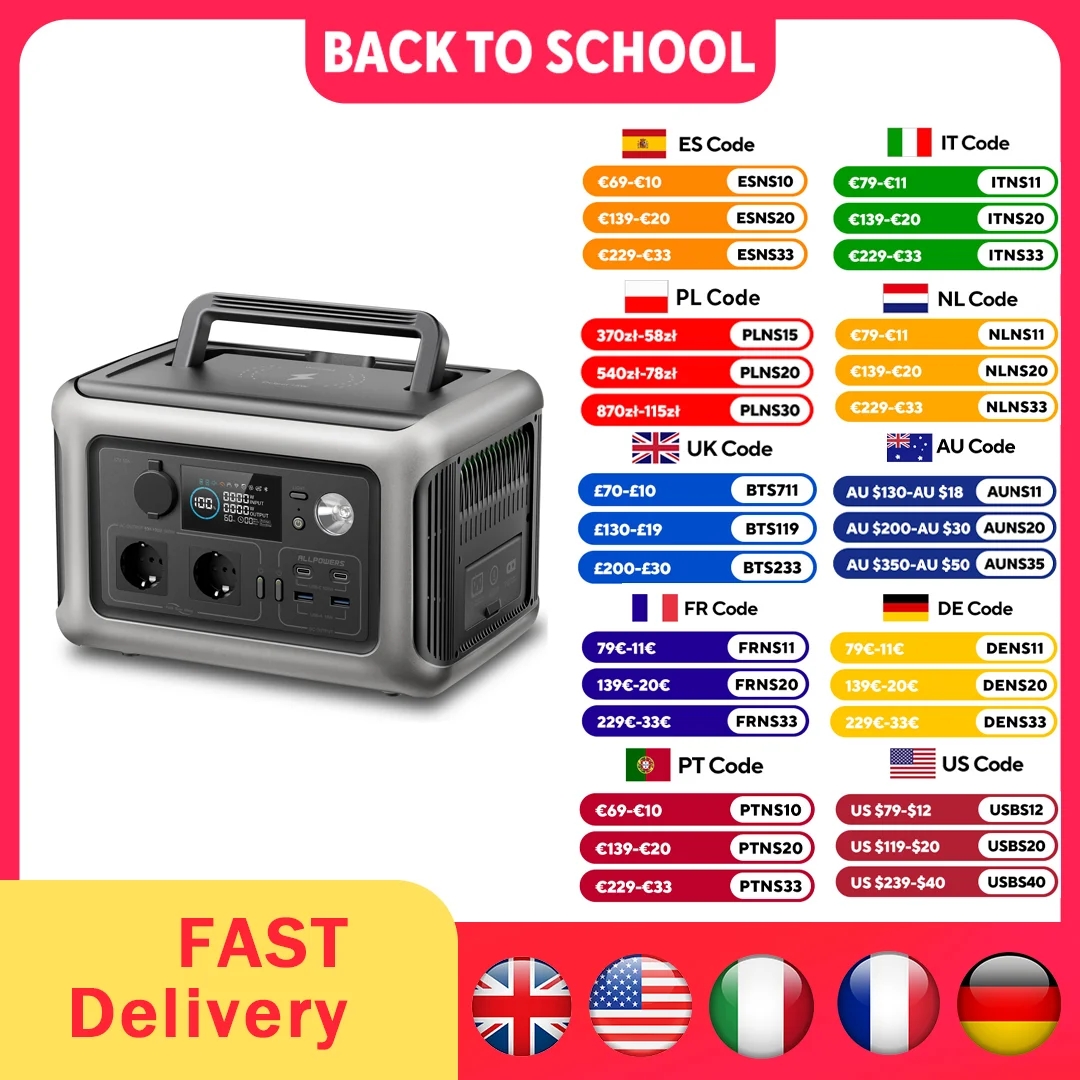
Practical limitations to consider: With 299Wh of total capacity, internal inverter conversion losses (typically 15% to 20% dissipated as heat and internal standby power) leave roughly 240–255Wh of usable AC energy. A standard 60W car fridge running on AC might deplete this unit within 4 to 5 hours of continuous duty, though switching to 12V DC output improves operational efficiency. Note that seller product photos show regional variations (such as European Schuko sockets); ensure you verify your market's plug type and voltage before ordering.
Mid-Size 1kWh Workhorses: EcoFlow DELTA 3 vs. OUKITEL P1000 PLUS
The 1-kilowatt-hour tier represents the most versatile balance of output power, battery reserve, and manageable transport. Both units featured below advertise 1024Wh LiFePO4 batteries and 1800W pure sine wave inverters, making them capable of operating standard 120V household loads like coffee makers, full-size refrigerators, and desktop workstations.
EcoFlow DELTA 3 (1024Wh / 1800W)
The DELTA 3 Classical Dark 1000 is advertised with a 1024Wh LFP battery, 1800W continuous AC output, and high-speed charging capabilities. Listing graphics claim an AC recharge rate capable of reaching 0 to 80% in approximately 45 minutes, alongside a stated unit weight of 26.7 lbs.
For an expanded breakdown of this specific model's ports and specifications, read our detailed analysis: EcoFlow DELTA 3 Portable Power Station: What the Listing Says.
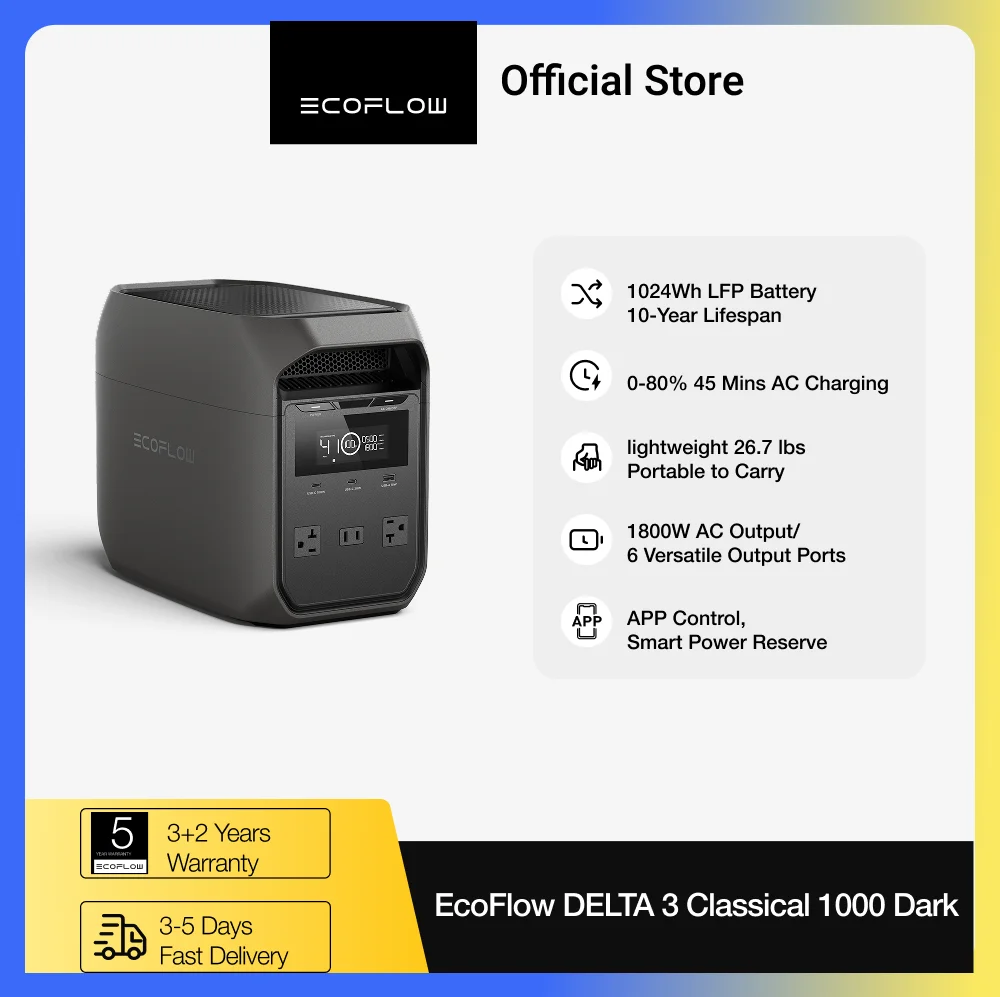
Best suited for: Users who require rapid turnaround times between grid interruptions, mobile remote workers needing reliable 100W USB-C PD power delivery, and car campers looking for a clean, integrated chassis design.
OUKITEL P1000 PLUS (1024Wh / 1800W)
The OUKITEL P1000 PLUS targets emergency preparedness directly. Alongside its advertised 1024Wh LiFePO4 battery and 1800W continuous output, the seller listing claims a 3600W surge capability and an uninterrupted power supply (UPS) transfer speed of approximately 10ms. This fast switchover is designed to keep desktop computers, network routers, and home servers running during sudden blackouts without rebooting.
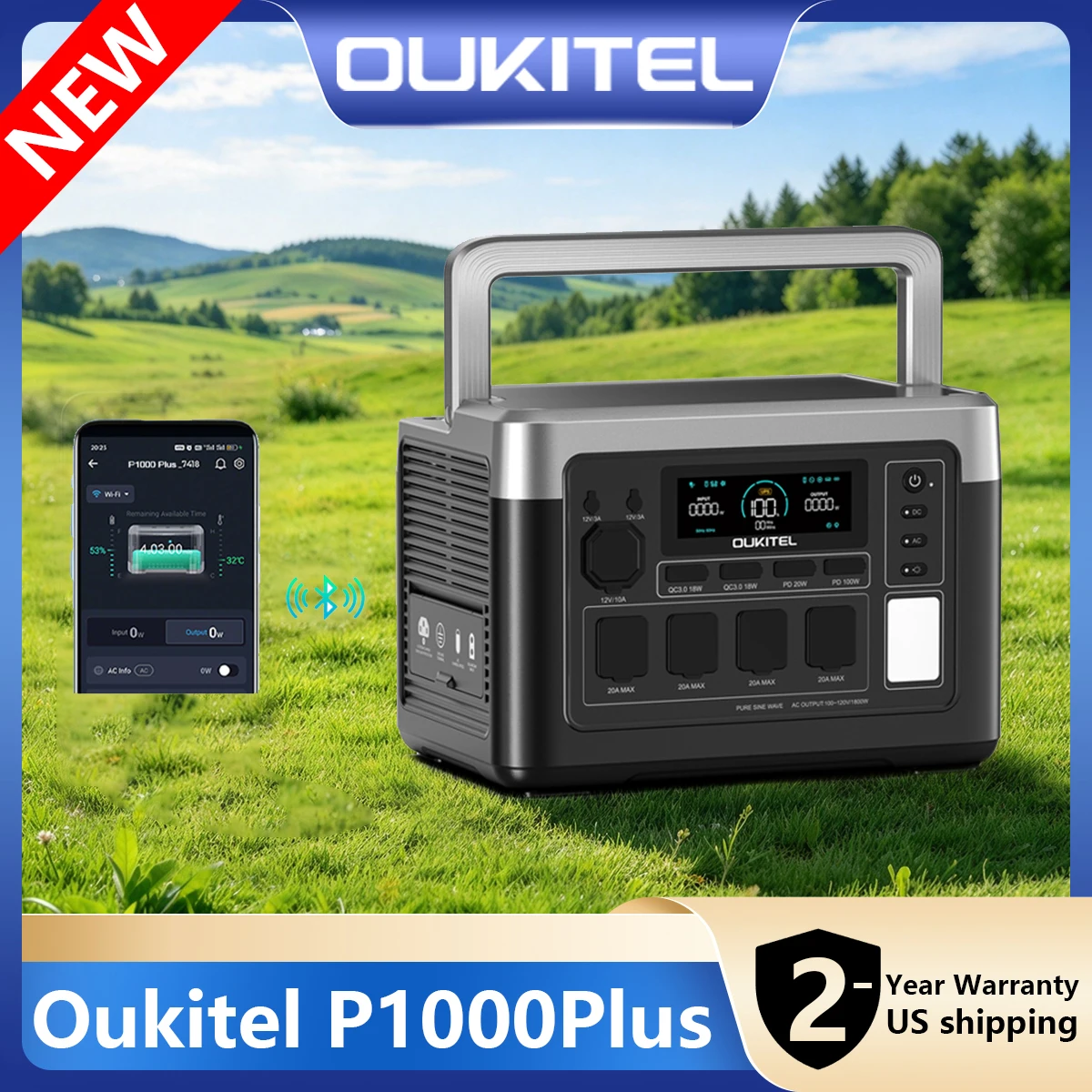
Best suited for: Home office protection and hurricane preparedness kits where multiple AC devices must remain connected simultaneously. Pictured units feature four grounded AC outlets and an integrated wide fold-down handle.
Mid-tier trade-offs: While an 1800W continuous rating can run demanding appliances like hair dryers or induction hotplates, operating at maximum inverter load will exhaust a 1024Wh battery in roughly 30 to 40 minutes. For long-term emergency cooking, pairing these stations with supplemental solar input or lower-wattage heating elements is strongly recommended.
Heavy-Duty Emergency Backup: SOLARPLAY 2400W (2160Wh)
When an outage stretches across several days or off-grid living demands running high-draw appliances simultaneously, small power banks become insufficient. The SOLARPLAY power station features an advertised 2160Wh battery capacity and a robust 2400W pure sine wave inverter (with an advertised 4800W peak surge rating).
For an in-depth look at managing extended home outages and calculating multi-day load profiles, see our comprehensive guide: Solar Generators for Home Backup: Capacity, Power and Realistic Runtime.
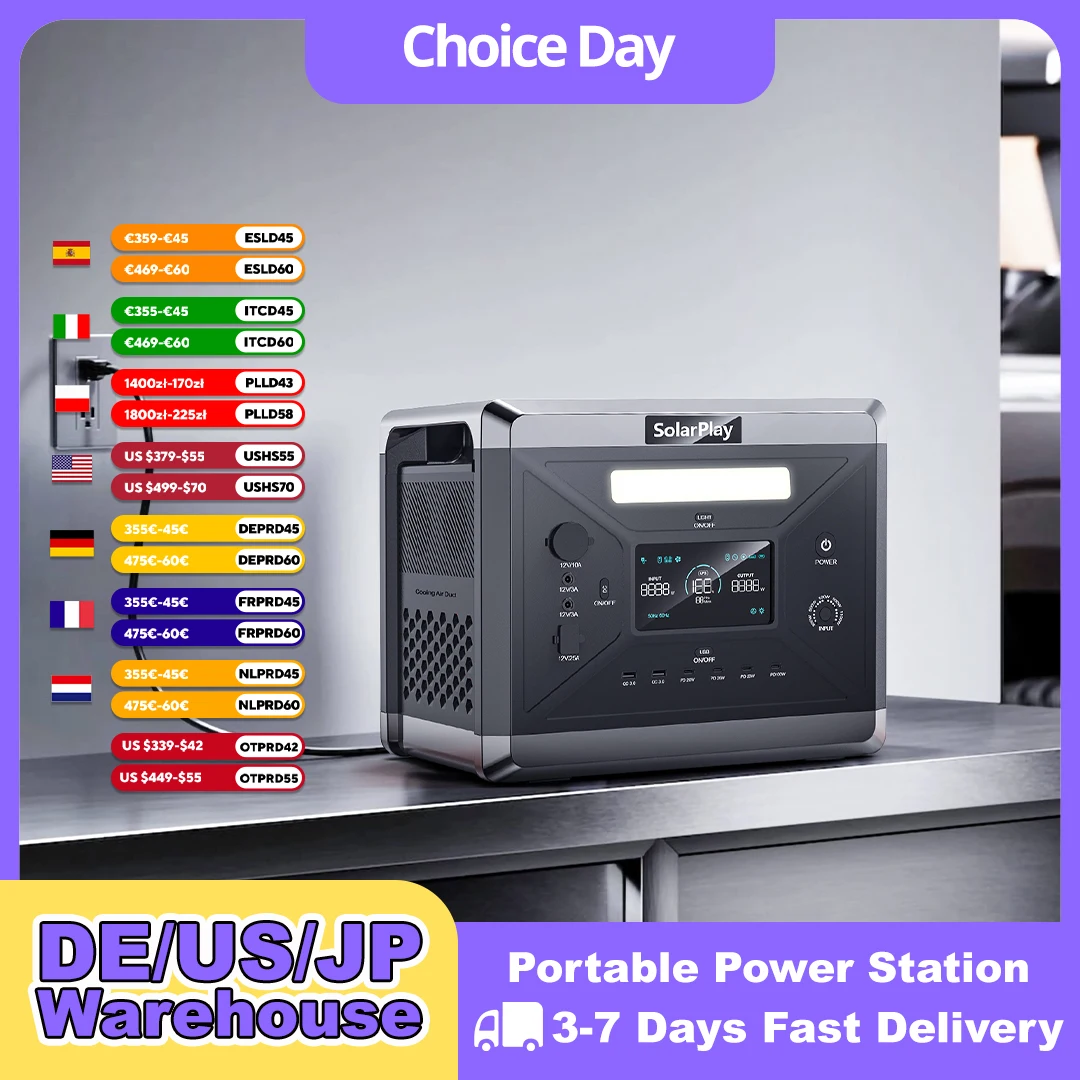
Best suited for: Running high-demand inductive loads, such as sump pumps, power saws, portable air conditioners, and household refrigerators over extended periods without tripping the inverter.
Physical and charging reality: A 2160Wh power station generally weighs over 45 pounds. Listing imagery shows built-in dual carry handles on the chassis, confirming that while it is portable, moving it frequently requires intentional effort. Furthermore, replenishing a battery of this size requires a robust AC wall connection or substantial solar input.
Solar Recharging & Connectivity: Essential Accessories
A portable power station is only as dependable as your ability to replenish it when the grid stays down. To operate independently off-grid, matching compatible photovoltaic panels and cables to your station's DC input limits is critical. Learn more about solar array matching in our review of the Best Solar Generator: Matching Capacity and Inverter Limits to Real Power Demands.

The Renogy 200W Portable Solar Panel provides a foldable, weather-resistant power source (advertised with IP65 ingress protection). A single 200W panel in peak, unshaded sunlight typically yields roughly 140W to 170W of real-world power into a station's internal MPPT controller, making it suitable for topping off a 1000Wh battery over a full sunny day.

To link standard solar panels to modern portable power stations, connection hardware must match. The Solar to XT60 Extension Cable (12AWG / 30A) adapts universal male/female solar connectors to an XT60 port—the standard DC solar input found on many modern EcoFlow, OUKITEL, and third-party units.
Understanding Inverter Loss and Battery Math
To avoid unexpected shutdowns during an outage, never assume that 1000Wh of battery capacity equals 10 hours of running a 100W load. A realistic runtime calculation must account for real-world inefficiencies:
$$\text{Estimated Runtime (Hours)} = \frac{\text{Battery Wh} \times 0.85}{\text{Device Wattage (W)}}$$
- Inverter Conversion Overhead: Inverters converting DC battery voltage into 120V/230V AC lose roughly 10% to 15% of total energy as heat.
- Idle Power Consumption: Keeping the AC inverter circuitry active draws between 10W and 30W continuously, even when no appliances are actively drawing power. For small DC devices (phones, tablets, USB lights), always use the direct USB or 12V car ports instead of AC wall plugs.
- Motor Surge vs. Running Watts: Refrigerator compressors, sump pumps, and power tools draw 2 to 3 times their running wattage for a split second when starting up. Ensure your station's surge wattage rating comfortably exceeds your appliance's startup requirements.
Pre-Purchase Verification Checklist
Before placing an order for a portable power station on marketplace platforms, confirm these critical details with the seller:
- Regional Voltage and Receptacles: Listing imagery frequently features international outlet types (such as EU Schuko or US 3-prong). Confirm that the specific SKU you select delivers your local grid voltage (120V 60Hz or 230V 50Hz) and matches your standard plug style.
- Shipping Destination and Restrictions: High-capacity lithium batteries face strict freight regulations. Verify that the seller has active logistics routes to your region and that local customs or hazardous materials fees are accounted for.
- Warranty and Customer Support Terms: While established brands frequently advertise 2- to 5-year warranties on their storefronts, review how warranty claims are fulfilled (local service center vs. international return shipping).