When you purchase portable power gear via links on Sine & Cell, we may earn an affiliate commission at no added expense to you. How Sine & Cell earns affiliate commissions
Folding solar panels bridge the gap between portable battery storage and genuine off-grid independence. However, shopping for portable solar arrays often means sorting through marketing wattage figures that rarely match field conditions. A panel labeled as 100W, 220W, or 400W produces that figure only under Standard Test Conditions (STC)—1,000 watts per square meter of irradiance at an exact 25°C (77°F) cell temperature. In realistic outdoor setups, factors like high ambient heat, haze, sun angle, and dust reduce sustained electrical harvest by roughly 15% to 30%.
Before selecting a folding panel, the primary technical consideration is not maximum advertised wattage, but whether the panel's open-circuit voltage (Voc) and working current align with your power station's onboard charge controller. Understanding these electrical boundaries protects your equipment and ensures predictable charging rates in camp or emergency backup scenarios.
Never connect a folding solar panel to a power station without verifying that the panel's open-circuit voltage (Voc) is strictly below the station's maximum input voltage limit. Exceeding maximum input voltage will trigger overvoltage protection or permanently damage the internal Maximum Power Point Tracking (MPPT) circuit.
Matching Solar Arrays to Power Station Inputs
When selecting a portable solar setup, your battery's charging controller dictates your panel requirements. If you are pairing panels with an existing unit—such as those evaluated in our guide to matching portable power station inverter output and capacity—take note of three specific limits published on your station's input port label:
- Maximum Voltage Input: Small stations commonly accept 10–28V DC, mid-sized units often handle 10–60V DC, and large home-backup generators can accommodate up to 150V DC or higher.
- Maximum Current Limit: If a station caps solar input at 8A or 12A, connecting a panel that produces 15A will not damage the unit (the controller draws only what it can handle), but any surplus amperage will be clipped and wasted.
- Connector Standard: Folding panels ship with varying terminations, ranging from bare MC4 leads to proprietary barrel plugs, XT60 connectors, or Anderson Powerpole fittings. Adapters introduce minor resistance and potential points of water ingress.
For high-capacity home setups discussed in our analysis of solar generators for home backup, multiple panels are frequently wired together. Keep in mind that wiring panels in series doubles voltage while keeping amperage constant, whereas wiring in parallel doubles amperage while maintaining array voltage.
Marketplace Options: Stated Specifications and Analysis
The following marketplace options represent popular portable folding form factors. Because listing pages often bundle multiple wattage tiers under a single entry, buyers must carefully inspect the exact variant selected at checkout.
MHPOWOS Multi-Fold Portable Solar Panel
The MHPOWOS listing encompasses multiple power tiers (advertised as 110W, 220W, and 400W variants) designed for camping, RV roofs, and general off-grid use. Pictured as a wide multi-panel fold-out blanket with integrated carrying handles, this style is built to collapse into a briefcase profile for transit.

The multi-fold format provides substantial surface area when deployed, but it requires adequate physical ground space or vehicle roof clearance. Key considerations for this listing include:
- Variant Wattage: The headline aggregates 110W, 220W, and 400W ratings. Confirm the specific wattage variant chosen in your shopping cart, as physical weight, panel count, and electrical output vary drastically between tiers.
- Connector Verification: The listing does not detail whether the output harness includes standard MC4 leads, DC5521 plugs, or station-specific pig-tails. Confirm terminal types with the seller prior to ordering.
- Support Structure: Multi-segment panels can sag if laid across uneven terrain, altering the angle of incidence relative to the sun and reducing performance. Check whether rigid kickstands or ground pegs are included in the package.
ALLPOWERS SE100 Monocrystalline Foldable Panel
The ALLPOWERS SE100 listing presents a 100W monocrystalline folding panel (with 200W variants also referenced in title metadata). Pictured with integrated fold-out kickstands, this design prioritizes quick angling toward low-horizon sun without requiring external props.
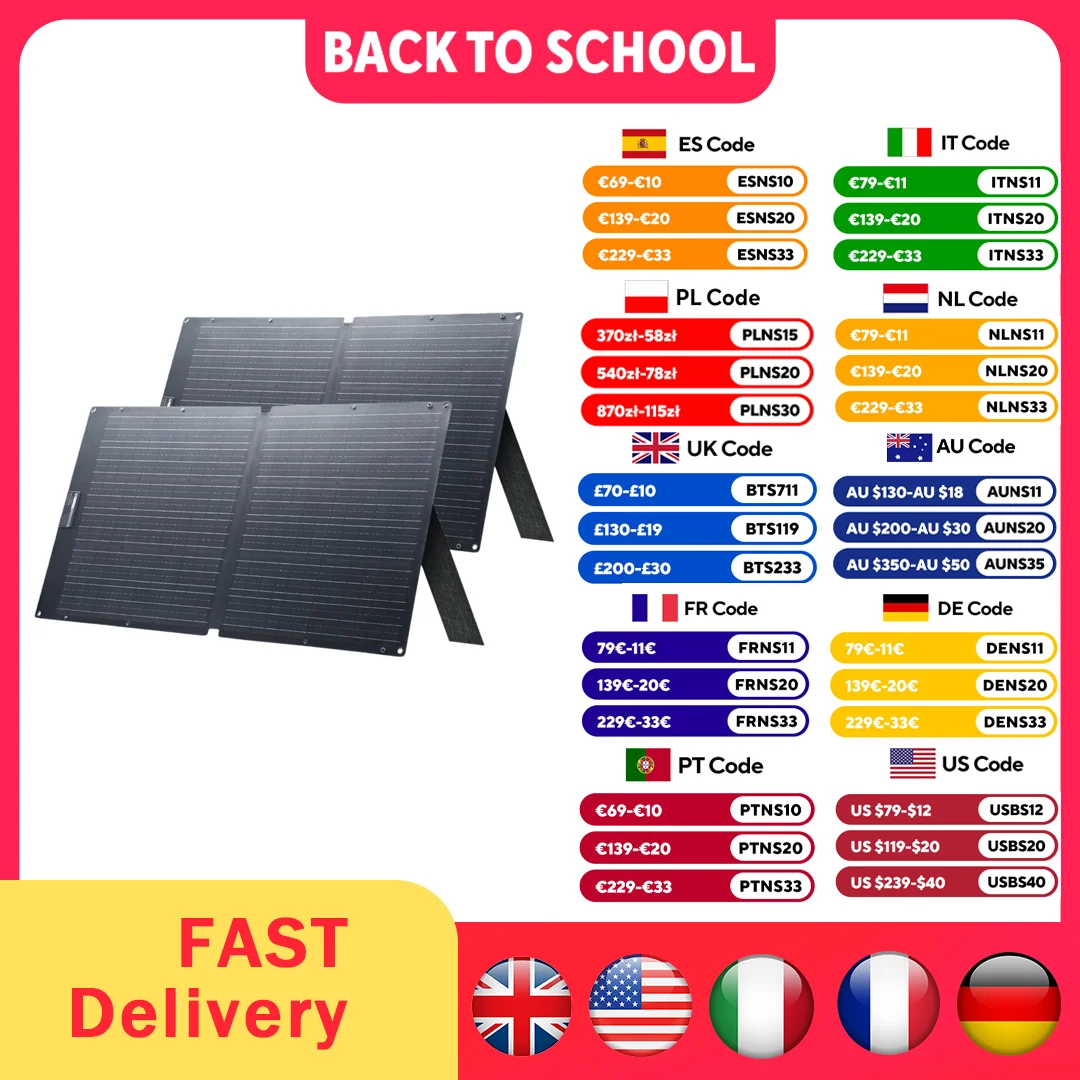
The listing advertises an IP68 waterproof rating and monocrystalline solar cell construction. Points to verify include:
- Weather Resistance Limits: While an IP68 rating denotes high ingress protection against water and dust for the panel lamination, the output junction box and cable terminals must be examined to verify they share that seal before leaving the array out in sustained heavy rain.
- Voltage Profile: Smaller 100W panels commonly output around 18V to 20V at maximum power (Vmp). This makes them well-suited for entry-level and mid-range stations, but buyers should check the exact spec sheet to confirm compatibility with their power station's MPPT operating window.
- Mechanical Stand Stability: Two-fold kickstand designs are stable on flat surfaces, but high wind gusts can catch the panels like a sail. Securing eyelets or guy lines may be necessary in exposed environments.
Feature Comparison
The table below summarizes the advertised attributes of both models based strictly on supplier listing data captured on October 27, 2026. Unverified specifications must be confirmed directly with manufacturers or sellers.
| Attribute | MHPOWOS Folding Panel | ALLPOWERS SE100 |
|---|---|---|
| Stated Wattage Range | 110W / 220W / 400W (variant dependent) | 100W / 200W (variant dependent) |
| Cell Type Stated | Not verified in listing title | Monocrystalline |
| Waterproof Rating Stated | Advertised "Waterproof" (unrated standard) | Advertised IP68 |
| Reference Price (USD) | $77.89 (as captured) | $106.49 (as captured) |
| Visible Mounting / Support | Carrying handles visible; stands unverified | Integrated fold-out kickstands pictured |
| Operating Voltage / Current | Not verified (consult seller) | Not verified (consult seller) |
Essential Pre-Purchase Verification Checklist
When shopping for marketplace solar panels where detailed specification sheets are not fully documented upfront, ask the supplier or verify on the packaging label the following points before deployment:
- Check the Open Circuit Voltage (Voc): Compare this figure against the maximum allowable DC solar input voltage on your battery generator. In freezing ambient conditions, Voc can rise beyond nominal room-temperature ratings by 10% to 15%.
- Confirm the Output Plug Profile: Ensure you have the exact adapter required for your power station. If the panel terminates in standard MC4 connectors, verify whether an MC4-to-XT60, MC4-to-DC7909, or MC4-to-Anderson cable is provided in the box or must be sourced separately.
- Inspect Lamination Type: Panels laminated with ETFE offer significantly greater resistance to thermal aging and micro-cracking compared to cheaper PET films, which tend to degrade and delaminate when exposed to direct summer heat over long periods.
- Assess Stowed Dimensions and Weight: A 400W folding panel can weigh between 25 and 35 pounds and measure over three feet across even when folded, making it challenging for solo backpack transport. Conversely, 100W panels are far more manageable for vehicle camping or impromptu patio use.
Understanding your system's electrical headroom and treating marketplace peak-power claims with realistic outdoor expectations will prevent damaged power stations and provide reliable charging whenever you venture off the grid.
Evaluation is based on published specifications and seller listings. No physical or hands-on testing was conducted; unlisted specifications may still be available from the seller.