When you purchase portable power gear via links on Sine & Cell, we may earn an affiliate commission at no added expense to you. How Sine & Cell earns affiliate commissions
Selecting a portable power station requires balancing two distinct electrical ratings: continuous inverter output (measured in watts) and total battery capacity (measured in watt-hours). Continuous wattage determines what appliances you can start and run simultaneously, while watt-hours dictate how long that load can operate before the battery depletes.
Bluetti offers several models in the popular 1 kWh to 2 kWh mid-tier bracket, as well as lightweight excursion units. This guide breaks down the seller-advertised capabilities of the established AC180 against the newer Elite V2 series, highlighting battery chemistry, claimed charging speeds, and essential verification checkpoints before you purchase.
The 1 kWh Class: Bluetti AC180 vs. Elite 100 V2
The 1,000 Wh tier is widely considered the sweet spot for camping, mobile trade work, and temporary home outage protection. Both the AC180 and the Elite 100 V2 share an advertised 1,800 W continuous pure sine wave output and LiFePO4 (lithium iron phosphate) battery chemistry, but they feature minor differences in energy storage and integration.
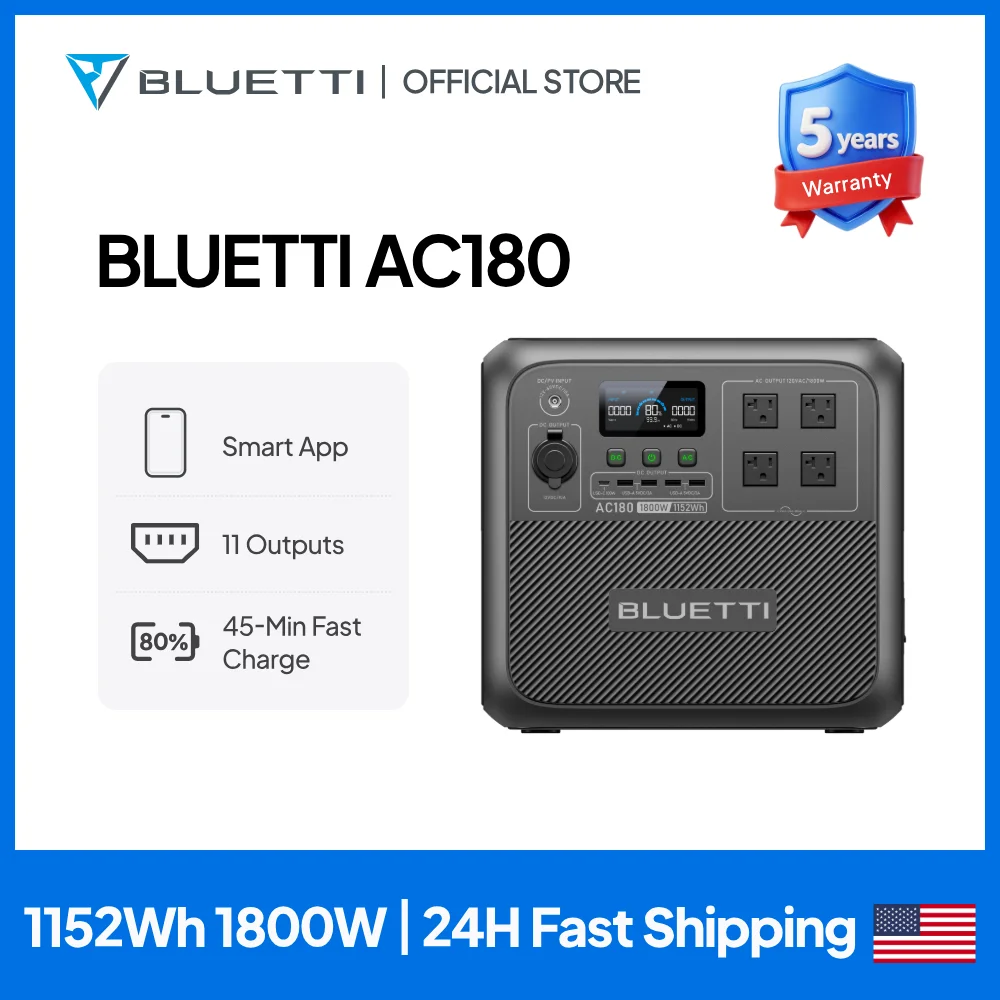
The BLUETTI AC180 listing specifies a 1,152 Wh storage capacity, a 2,700 W surge threshold, mobile app connectivity, and an advertised 45-minute fast charge to 80%. It is supplied in brand-new condition from the manufacturer's storefront.
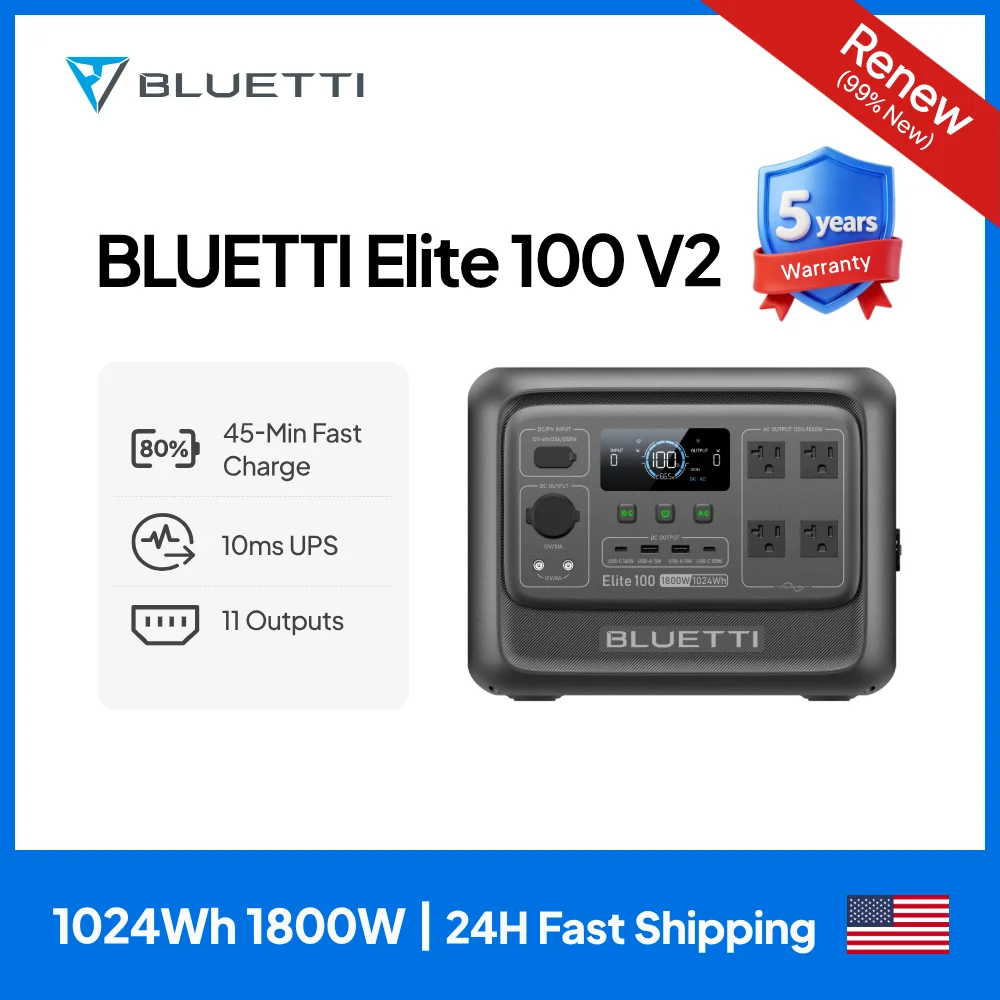
In contrast, the BLUETTI Elite 100 V2 listing shows 1,024 Wh capacity and an 1,800 W inverter rating, paired with a seller-advertised 10 ms UPS switchover rating and 11 output ports. Note that this specific listing is designated as "Renewed" (graded 99% new by the seller), which represents a factory refurbished unit rather than an unopened retail package.
| Specification Metric | BLUETTI AC180 (New) | BLUETTI Elite 100 V2 (Renewed) |
|---|---|---|
| Advertised Battery Capacity | 1,152 Wh | 1,024 Wh |
| Continuous AC Inverter Output | 1,800 W | 1,800 W |
| Surge / Maximum Rating | 2,700 W surge claimed | Not stated in listing text |
| Battery Cell Chemistry | LiFePO4 | LiFePO4 |
| Condition & Warranty Claim | Brand New / 5-Year Badge | Renewed / 5-Year Badge |
High-Capacity Emergency Backup: BLUETTI Elite 200 V2
For high-draw appliances such as sump pumps, full-size domestic refrigerators, or power tools that demand significant running power, a 2 kWh unit provides broader operational headroom. If you are configuring a system primarily for prolonged residential power cuts, review our analysis on solar generators for home backup and realistic runtimes.
The BLUETTI Elite 200 V2 offers an advertised 2,073.6 Wh battery capacity paired with a 2,600 W continuous inverter, alongside promotional graphic claims of up to 3,900 W maximum output and 15 ms UPS changeover. A claimed 60-minute fast charge to 80% enables rapid turnaround from standard wall power or appropriately sized solar arrays. Note that this specific listing is also designated as a seller-refurbished ("Renewed") model.

Compact Field Power: BLUETTI Elite 30 V2
When packing space and carrying weight are primary constraints, full-sized 1,000 Wh stations can prove cumbersome. The BLUETTI Elite 30 V2 targets short excursions, camera equipment, mobile laptops, and lightweight field charging with an advertised 288 Wh capacity and 600 W output rating.

Supporting Accessories and Cables
Power stations often require specialized cabling or protective transit gear depending on how they are deployed in vehicles or outdoor workspaces.

A dedicated 12V car cigarette lighter charging cable allows top-up charging while driving. Listing #5 advertises compatible fitment for the Elite 100 V2 and Elite 30 V2 models using an XT60-style DC input connector. When charging from a vehicle 12V socket, actual charge wattage is inherently constrained by the vehicle port fuse (typically 10A to 15A at roughly 12V to 13.8V DC), meaning full recharges from empty will take significantly longer than AC grid charging.

A padded storage bag with carry straps (such as listing #6, advertised for the AC180 and AC2A) protects connection ports from dust and mechanical scuffing during transit. If you plan to charge your power station with solar panels in the field, read our breakdown on selecting folding solar panels to ensure voltage and connector compatibility.
Critical Verification Steps Before Purchasing
- Refurbished vs. Brand New: Listings marked "【Renew】" indicate renewed or refurbished items. Verify the seller's specific warranty terms, return windows, and whether all original AC and DC charging cables are bundled in the package.
- Inverter Conversion Losses: An internal AC inverter typically consumes between 10% and 20% of stored battery energy due to thermal and conversion overhead. To estimate realistic runtime, multiply stated capacity by 0.85 before dividing by your load wattage (e.g., $1024\text{ Wh} \times 0.85 \div 100\text{ W} \approx 8.7\text{ hours}$).
- Solar Input Voltage Windows: Before connecting third-party solar arrays, consult the unit's rating plate for the exact Open Circuit Voltage ($V_{oc}$) limit. Exceeding the internal MPPT controller's maximum allowable input voltage can permanently damage the power station.
- Delivery Destination: Confirm local carrier handling and address eligibility at checkout, as large lithium-based battery units are subject to hazardous goods shipping classifications.
Evaluation is based on published specifications and seller listings. No physical or hands-on testing was conducted; unlisted specifications may still be available from the seller.